∙
Cooper
∙
Reading time:
11 min

Repetitive questions waste time. If your team uses Slack daily, you’ve likely seen how support threads can quickly spiral into inefficiency. Enter context-aware AI agents, tools designed to understand your workflows and deliver precise, actionable answers directly inside Slack.
Here’s the key takeaway: Slackbot and Question Base are two AI tools with different strengths. Slackbot focuses on improving individual productivity by summarizing conversations and drafting content using Slack’s internal data. Question Base, on the other hand, connects to trusted documentation platforms like Notion and Confluence to provide verified answers to repetitive questions, saving teams hours each week.
Why these tools matter:
Employees spend 12 hours per week searching for information.
40% of internal questions are repeats of previously answered ones.
80% of employees prefer asking questions in chat tools like Slack.
Slackbot and Question Base solve these challenges by delivering answers where teams already work. Whether you need quick summaries or verified documentation, these tools bring efficiency to Slack workflows.
Quick Comparison:
Feature | Slackbot | Question Base |
|---|---|---|
Focus | Summarizing conversations | Delivering verified answers |
Data Sources | Slack messages, files, etc. | Notion, Confluence, Salesforce |
Analytics | Basic usage stats | Detailed knowledge gap tracking |
Setup | Built into Slack | Simple app installation |
Best For | Individual productivity | High-volume support teams |
Bottom line: Slackbot boosts personal efficiency, while Question Base ensures reliable answers at scale. Together, they help teams save time and reduce repetitive work.
Build a Slack AI Agent That Answers Questions (Step-by-Step Tutorial)
Why Context-Aware AI Agents Matter for Enterprise Teams
Context-aware AI agents understand the nuances of your team's workflow - tracking conversational history, priorities, and decision-making habits to provide responses that fit seamlessly into the moment at hand [1]. Rather than just cutting down on manual searches or tedious data entry, these agents pull insights through cross-platform knowledge retrieval from collaborators, channels, calendars, and shared documents to deliver highly relevant answers [1].
The results speak for themselves. Employees spend a significant amount of time hunting for information, and around 40% of internal enterprise questions are simply repeats of answers already given [2]. By instantly delivering verified responses, context-aware agents eliminate this redundancy. Maria Jensen, UX Lead & Scrum Master at Ticketbutler, highlighted the transformation:
"Before, we could easily spend 5–10 minutes searching... Now, QB finds the relevant answers in a few seconds." [2]
This matters even more when you consider that 80% of employees prefer asking questions in a chat interface rather than digging through a traditional company wiki [2]. When AI tools integrate directly into platforms like Slack, they meet employees where they already work - avoiding the need for disruptive context-switching. Linn Stokke, Online Events & Marketing Specialist at Ticketbutler, shared how this integration streamlined their processes:
"Since we started using QB we haven't used our Google support docs. And if I go on vacation or sick leave, I feel comfortable that QB will just take over." [2]
The key difference between context-aware agents and traditional search tools lies in synthesis versus retrieval. While traditional search engines simply pull up documents, context-aware agents analyze user context and conversational history to craft tailored, actionable answers [1]. This shift changes how enterprise teams manage knowledge, replacing endless searches with instant solutions.
For teams in HR, IT, and operations where question volumes can be overwhelming, this synthesis power is a game-changer. It’s not about replacing human expertise but ensuring it scales effectively - delivering the right knowledge to thousands of employees without overloading support teams or leaving critical gaps unaddressed.
1. Slackbot
Context-awareness
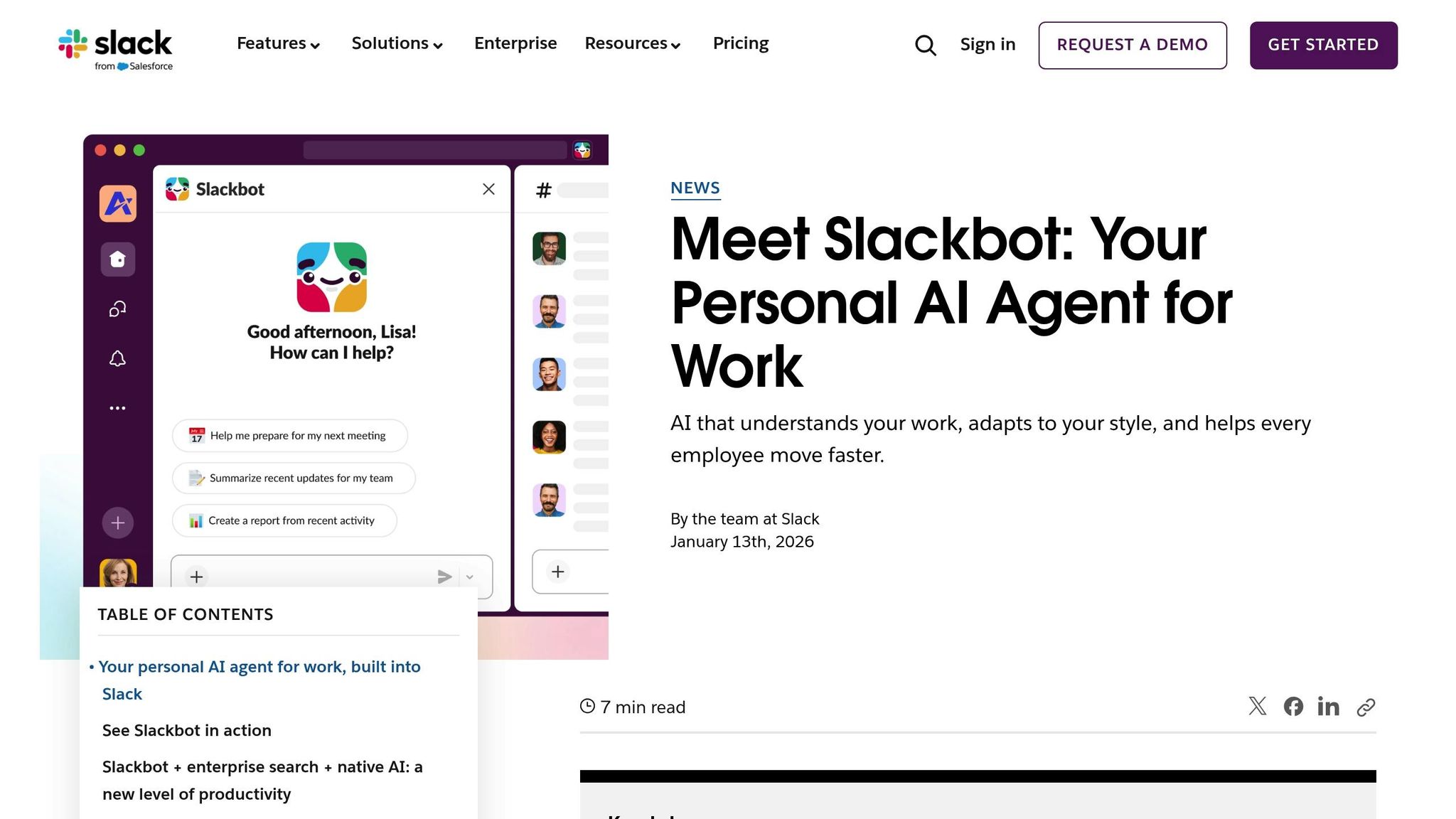
Slackbot has evolved into a more intuitive, context-aware assistant, seamlessly weaving team conversations with essential calendar events and document links [1]. Unlike generic AI tools, it behaves as though it has attended every meeting, drawing from message histories, threads, documents, and calendars [1]. This means when you ask it to summarize a business review or identify potential blockers before a meeting, it already understands the background without needing extra input.
Using natural language processing, Slackbot allows employees to ask questions in plain language, eliminating the need to search for exact keywords. Every response includes clear citations that link back to the original messages or files, fostering transparency and building trust [1].
This level of contextual understanding forms the backbone of Slackbot’s ability to integrate deeply and perform at scale.
Integration depth
Slackbot’s reach goes well beyond Slack’s own platform. Through a custom API connector - a secure tool for linking external systems - organizations can search across various knowledge hubs like Google Drive, Salesforce, OneDrive, and even on-premise software [3]. The system respects enterprise roles and permissions, ensuring users only access information they are authorized to see [1][3].
By effortlessly connecting to broader knowledge ecosystems, Slackbot minimizes redundant searches and enhances workflow efficiency.
Scalability
Slackbot’s design ensures it can handle the growing demands of expanding organizations. During early testing at Salesforce, users reported saving at least 90 minutes daily by relying on Slackbot to automate information retrieval and synthesis [1]. It can process complex files, extracting trends or key insights in mere seconds [1][3]. Additionally, as companies adopt more third-party agents, Slackbot serves as a central coordinator, seamlessly managing tasks across multiple systems [1].
The rollout for Business+ and Enterprise+ customers began in January 2026, with further expansion continuing into February 2026 [1].
2. Question Base
Context-awareness
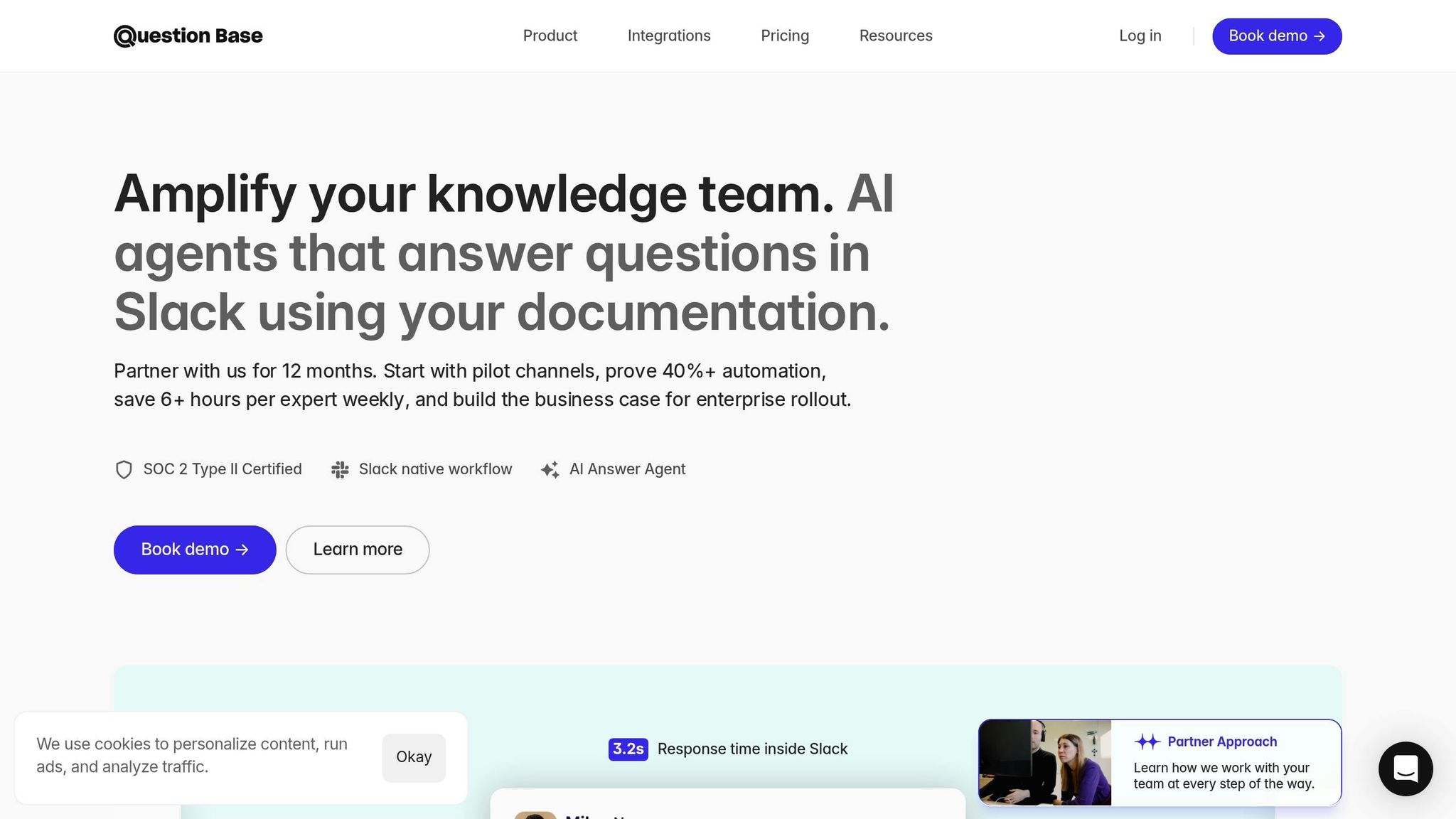
Question Base stands out by prioritizing verified, expert-approved answers over relying solely on chat history. Unlike Slackbot, which pulls from Slack chat data, Question Base ensures that every response is grounded in trusted, official documentation. It integrates directly with your organization’s most reliable sources, such as Notion pages, Confluence spaces, Salesforce records, and Google Drive files, providing accurate answers in an impressive 3.2 seconds[2].
When the system encounters a gap in the available information, it flags the issue and alerts knowledge managers. This creates a feedback loop that helps refine and expand your documentation over time. This shift toward agentic workflows ensures that AI doesn't just automate tasks but actively improves the knowledge base.
Integration depth
Beyond its focus on accuracy, Question Base enhances its functionality through a wide range of integrations. It seamlessly connects with tools like Notion, Confluence, Salesforce, Zendesk, Google Drive, Jira, and Dropbox, pulling from resources such as databases, blog posts, and support cases. These integrations are included in the Pro plan, which starts at $8 per user per month. Organizations maintain full control over what content the AI can access, ensuring employees only see information they’re authorized to view.
Organizational impact
These extensive integrations deliver tangible benefits for teams handling high volumes of support requests with digital coworkers. Question Base provides analytics on automation rates, resolution times, and knowledge gaps, offering actionable insights to improve documentation and workflows.
For enterprise-level implementation, pricing starts at $6,000 per year[2], which includes hands-on setup and ongoing support to align the system with your team’s processes. For industries with strict regulatory requirements, such as those needing SOC 2 Type II compliance or on-premise deployment, the Enterprise tier offers advanced options like white-labeling and multi-workspace support, with custom pricing available.
Strengths and Limitations
Slackbot vs Question Base: Feature Comparison for Enterprise Teams
In the fast-changing world of context-aware agents, balancing ease of use with reliable data is key. Slackbot shines in synthesizing real-time context, while Question Base focuses on delivering answers backed by expert verification.
Slackbot taps into live conversations, huddles, canvas files, and calendars to piece together how decisions are made within your Slack workspace[1]. It requires no extra setup and seamlessly adopts existing enterprise permissions, making it a convenient option for Slack users.
On the other hand, Question Base ensures every answer is cross-checked against trusted organizational sources like Notion, Confluence, Salesforce, and Google Drive - delivering responses in an impressive 3.2 seconds[2]. When no answer is available, it notifies managers, creating a feedback loop that strengthens documentation over time.
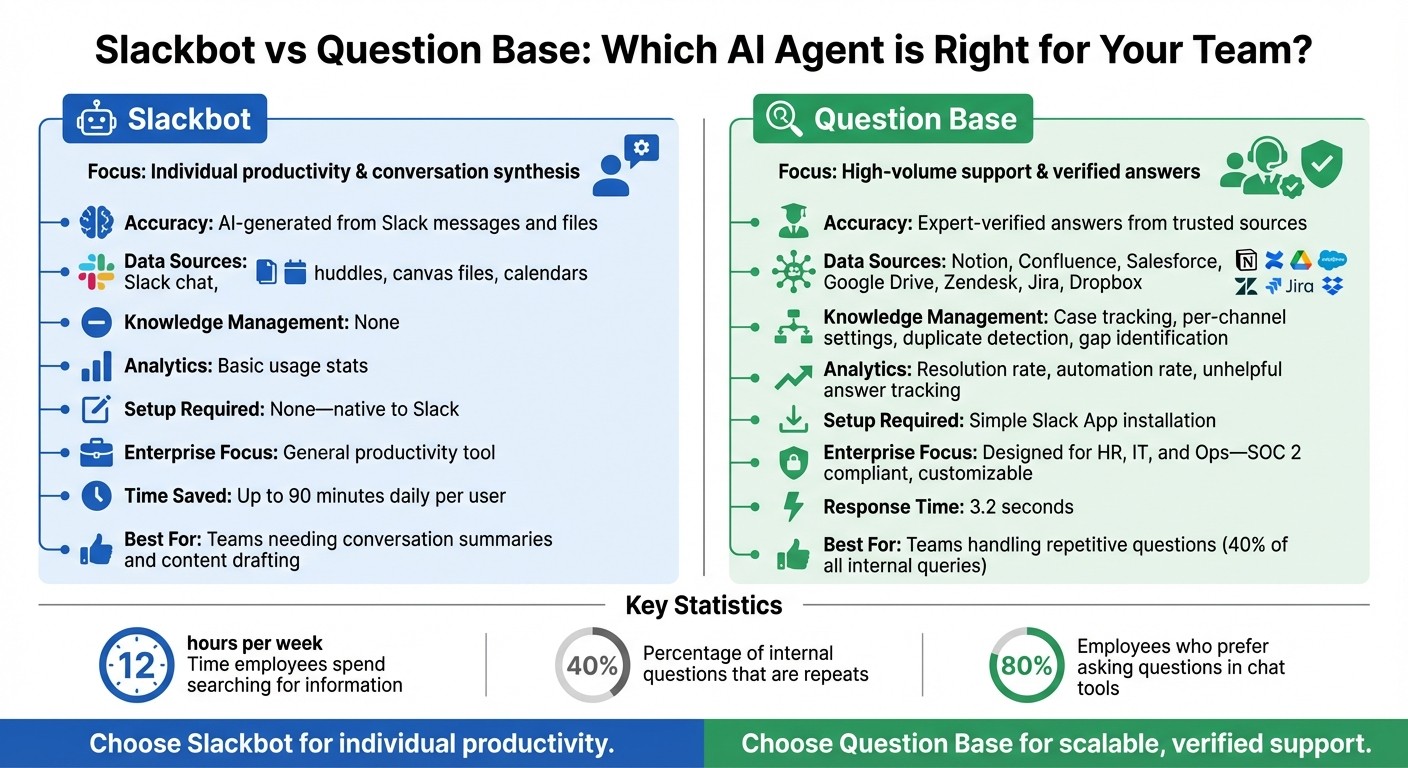
The differences become more apparent when you compare Slack knowledge bases vs traditional management systems and analytics. Slackbot provides basic usage stats but doesn’t track knowledge gaps or measure resolution rates. Question Base, however, offers in-depth analytics, including automation rates, unhelpful answer tracking, and duplicate detection - essential for teams dealing with repetitive questions, which make up 40% of internal enterprise queries[2].
Here’s how the two compare:
Feature | Slackbot (Slack AI) | Question Base |
|---|---|---|
Accuracy | AI-generated from Slack messages and files | Expert-verified answers from trusted sources |
Data Sources | Slack chat, huddles, canvas files, calendars | Notion, Confluence, Salesforce, Google Drive, Zendesk, Jira, Dropbox |
Knowledge Management | None | Case tracking, per-channel settings, duplicate detection, gap identification |
Analytics | Basic usage stats | Resolution rate, automation rate, unhelpful answer tracking |
Setup Required | None - native to Slack | Simple Slack App installation |
Enterprise Focus | General productivity tool | Designed for HR, IT, and Ops - SOC 2 compliant, customizable |
Slackbot is a great choice for teams looking for quick productivity boosts and conversation summaries. However, for organizations in industries like finance, healthcare, or education that need verified knowledge, audit trails, and deep operational insights, Question Base offers specialized features tailored to meet enterprise-level needs.
Conclusion
From our analysis, it's clear that context-aware agents are reshaping enterprise support by aligning responses with real-world workflows. These AI tools are transforming the way companies manage knowledge, but selecting the right one depends on your team's specific challenges.
Take Slackbot, for example. It's a great fit for summarizing conversations, drafting content, and helping team members catch up on missed discussions. By streamlining individual workflows, Slackbot significantly boosts productivity for Slack users.
On the other hand, Question Base is designed to tackle large-scale support issues. Built for high-volume teams, it provides verified, expert-backed answers to repetitive questions. Whether it's HR fielding endless benefits inquiries, IT managing password resets, or operations clarifying documented processes, Question Base saves time and reduces the need for staff to wait on busy managers. Its focus on efficiency makes it a game-changer for teams overwhelmed by recurring requests.
These tools highlight how tailored solutions can meet distinct enterprise needs. Choose Slackbot if your team is looking to manage information overload and improve individual productivity - it can save users up to 90 minutes daily[1]. Choose Question Base if your organization needs to cut down on redundant inquiries, access verified answers from trusted sources like Notion or Confluence, and track knowledge gaps with detailed analytics to measure ROI of knowledge sharing.
For large enterprises, especially in regulated industries like finance, healthcare, or education, these tools can work together seamlessly. Slackbot enhances individual efficiency, while Question Base ensures teams have reliable, audit-ready answers for compliance-heavy, policy-driven information. Together, they offer a comprehensive approach to managing organizational knowledge and support.
FAQs
How do context-aware AI tools like Slackbot enhance productivity in the workplace?
Context-aware AI tools, like Slackbot, boost workplace efficiency by delivering quick and precise answers from reliable sources. They handle repetitive tasks automatically and turn conversations into searchable knowledge, cutting down the time spent hunting for information and reducing disruptions to workflows.
By tapping into contextual data, these tools simplify tasks such as internal knowledge sharing, supporting growing teams, and managing large volumes of frequently asked questions. This helps teams stay on the same page, make informed decisions, and dedicate their energy to more meaningful work.
How does Question Base handle repetitive questions differently from Slackbot?
Question Base sets itself apart from Slackbot by providing accurate and verified answers directly from trusted documentation sources like Notion, Confluence, and Salesforce. While Slackbot primarily helps individual users by referencing context from Slack messages and channels, Question Base is tailored for enterprise teams - think HR, IT, and operations - who need to handle repetitive, high-volume questions efficiently.
The key difference lies in how they source information. Slackbot relies on Slack's chat history, which can sometimes lead to incomplete or inaccurate responses. In contrast, Question Base integrates directly with authoritative knowledge bases, reducing the chances of misinformation and ensuring compliance with company standards. Additionally, it offers enterprise-level tools like case tracking, duplicate detection, and analytics to evaluate answer quality and uncover knowledge gaps. These features make Question Base a more dependable and streamlined solution for managing recurring inquiries across teams.
Why are context-aware AI agents important for enterprise teams?
Context-aware AI agents play a crucial role for enterprise teams by aligning with an organization’s unique workflows, data, and guidelines. This alignment ensures their responses are not only accurate but also relevant to the specific needs of the business. Without this context, AI systems risk delivering generic or even incorrect answers, potentially causing disruptions or creating compliance issues.
When these agents draw from reliable organizational knowledge, they deliver precise and actionable responses. This capability helps automate repetitive tasks, save time, and support better decision-making. For teams in HR, IT, support, and operations, the benefits are clear: quicker resolution of inquiries, smoother knowledge sharing, and adherence to internal policies. These improvements drive productivity and build trust throughout the organization.